

A partnership already in motion. A bigger journey to share.
Working document prepared for Patrick Santschi and Amandine Laval — Edmond de Rothschild. May 11, 2026.
You already know us. The recap to align the basics.
The dual foundation
Mines Paris-PSL + European founders (Xavier Niel, Bernard Arnault, Rodolphe Saadé).
The pedagogical model
Five integrated years Bachelor → Master across four pillars: Mathematics, Business, Data, Humanities. Tracks in Data for Business, Finance, Sustainability + MSc AI & Entrepreneurship in apprenticeship.
The perimeter
650 students · 5 campuses (Paris, Madrid, Milan, Geneva, Marseille) · 38 nationalities · founded in 2021.
Albert School is going big. The Future Partners architecture is how we get there.
The school has reached the inflection point where it can no longer scale only by adding programs and campuses. The next chapter is a deliberate move to build a network of partner companies engaged with us on the long horizon — talent, training, research, and innovation. We call it Future Partners. It is the architecture for how Albert School and the most ambitious organisations in Europe are going to grow together.
Talent at scale
A continuous pipeline of hybrid graduates — Business × Data × AI × Humanities — flowing into partner organisations through internships, apprenticeships, and full-time hires.
Continuing education at the edge
Executive Education designed for the specific question of how teams operate when AI augments individual output. Not a catalogue. Custom interventions, calibrated to the partner's reality.
Research and innovation, shared
Joint research on the transformations AI imposes on training, hiring, and management. A space where partner companies and academic teams build the playbook for the next decade together.
Future Partners is not a service catalogue. It is a long-cycle engagement. We are choosing the small number of organisations we want to walk this path with — and Edmond de Rothschild is one of the conversations we want to have first.
Three levels, two stages — one matrix of where we plug in.
In the last twelve months, we have specialised our Executive Education practice around a simple matrix. Three rows for the level of intervention — individual, team, governance. Two columns for the stage of the partner organisation's AI journey — ideation of the AI roadmap, or prioritisation and roll-out at scale to unblock an existing roadmap. Six cells. Each one a different conversation, a different format, a different deliverable.
Awareness of available tools, foundational prompting, first use-cases. Build a shared baseline across the population so the conversation can begin.
Role-by-role power-user training. Push productivity by function — relationship managers, analysts, operations, support — wherever the organisation has already committed to the tools.
Design the AI Ambassador community — who, what mandate, what diffusion model. Build the playbook before the rollout.
Construct agentic workflows in production — across HR, marketing, operations, finance, risk. Diffuse via the ambassador network. Measure adoption, iterate, scale.
ExCo training that confronts the hard questions early — cost trajectory, change management, impact on the workforce, sustainability impact of AI. Most organisations avoid these conversations until they break. We open them at the start.
Governance frameworks for roll-out at scale — KPI architecture, escalation paths, risk reviews, communications strategy, board-level reporting cadence. The discipline that turns a strategy into an outcome.
Strategic governance is where Albert School distinguishes itself.
Most training providers stop at tools and team adoption. Our ExCo programs are designed to confront the cost trajectory of AI, the change-management cost, the workforce impact, and the sustainability impact of the technology itself. We don't shy away from the elephants in the room — we put them on the agenda.
From individual contributor to senior governance — the same method, three scales.
Our Executive Education engagements activate when an organisation has a specific question to address — a leadership team to align, a function to upskill, a population to bring up to speed on an AI topic. Three recent examples to give the range.
Training the hospital management on generative AI
For the Assistance Publique-Hôpitaux de Marseille, an upskilling program built for the management layer — directors, department heads, administrative leadership. The objective: equip the leadership running a major public hospital with the AI fluency to make informed decisions on tools, governance, and care-pathway implications.
Building the AI Ambassador community
For Club Med, an AI Ambassador program training internal relays in each business line — HR, marketing, operations, finance. Each ambassador leaves with prototyped use cases, a shareable pattern, and the mandate to diffuse it in their team. The multiplier, not frontal training.
Aligning 24 executive committees on AI
One immersive day per executive committee — strategic kickoff, hands-on Copilot workshop, agents workshop with POC construction, activation roadmap. Format replicated identically across 20 cohorts. Satisfaction: 8.7/10.
Each case was custom. None is a template we re-applied. That is the point — Executive Education at Albert School calibrates to the actual question on the table, not to a pre-packaged curriculum.
The Business Deep Dive is the engine that connects our students to partner organisations — and the format that opens the door to everything else.
A real brief. A student team. From 2 days to 4 weeks of supervised work. A final presentation to the company jury. Edmond de Rothschild has already experienced the format with Edmond de Rothschild Asset Management — cross-campus, twelve teams. The mechanic works.
Sprint
Compressed format for short strategic questions.
Business Challenge
Standard format. Business, data, or AI case framed by Albert coaches.
Studio
Prototype format. Students deliver a tangible artefact.
Research-to-Business
Tri-partite with a Mines Paris-PSL research lab. For topics where science is a lever.
Full Entrepreneurial Experience
Pure entrepreneurial format with internal mentors only.
8 BDDs per Bachelor student per year. No repeat of company-format pairings. Multi-campus, cross-track, year-round. For partner organisations, this means a permanent calendar of engagement windows — short or long — triggered on demand.
Five centuries of schools. One reason the Future Partners architecture requires one.


To shape and provide future generations with knowledge and purpose.
Five centuries separate the two images above. They share an idea that no other institution reproduces. A school is the place where disciplines converge, where talent is formed across cohorts, where knowledge is built rather than purchased. The argument for partnering with a school — rather than a training provider — is not nostalgic. It is structural. The innovation flywheel you are building requires every pillar to turn together. Only a school can power them all.
Talent at flow
Students entering your organisation through apprenticeship, internship, and full-time hire. A training provider has no graduating cohort. A school does — every year, by design.
Research as a partner
Applied research, co-publication, co-funding on the long horizon. A training provider delivers content. A school produces knowledge — and shares the authorship.
Multi-disciplinary breadth
Mathematics, Business, Data, Humanities — under one roof, in the same curriculum. A training provider specialises in one slice. A school holds the whole and connects the parts.
Time horizon of decades
Student cohorts grow with you for ten, twenty years. The relationship compounds. A training provider's contract is annual; a school's is generational.
Institutional anchor
Mines Paris-PSL as founding partner. Leading European entrepreneurs as backers. A school carries the weight of the institutions behind it — not just the trainers it deploys.
The innovation flywheel has six pillars. A training provider can light one of them. Only a school can power them all.
This is why the conversation Albert School wants to have with Edmond de Rothschild is a partnership conversation — not a vendor conversation. The next sections of this page describe the framework, the mechanic, and the test combinations that make it operational.

Six entries. A 360° view of what a partnership with Albert School can be.
The Future Partners framework articulates six dimensions of the partnership. None is mandatory; none is exclusive. The right mix is calibrated partner by partner — and evolves over time.
Talent Access
Company presentations, recruitment, internships, apprenticeships, early-career opportunities. The most direct entry point.
Business Deep Dives
Real briefs, structured as pedagogical projects. The visibility format and the entry point to the broader collaboration.
Executive Education
Custom programs for managers and teams. Activated for specific transformations, not as a standing catalogue.
Innovation & Experimentation
A protected space to prototype AI use cases, test emerging topics, challenge hypotheses. With students or with our R&D team.
Thought Leadership
Co-creation of content, events, panels, white papers, executive briefings on the future of work and AI transformation.
Strategic Community
A curated network of organisations engaged on the same questions — peers who are also walking this path.
A seventh entry — co-funding a research chair.
For the deepest engagements, we are opening conversations on co-funded research chairs on the transformations AI imposes on training, hiring, and management. Applied research, co-authored, co-published. Available for partners ready to engage at this depth.
Future Partners is not a service catalogue. It is a double flywheel — Albert School's loop and the partner organisation's loop, coupled.
The framework works because each pillar of engagement reinforces every other pillar — for both sides of the partnership. Albert School gets richer cases, stronger placements, sharper reputation. The partner organisation gets earlier access to talent, faster AI adoption, stronger competitive position. The two flywheels are coupled: a turn on one side accelerates the other.
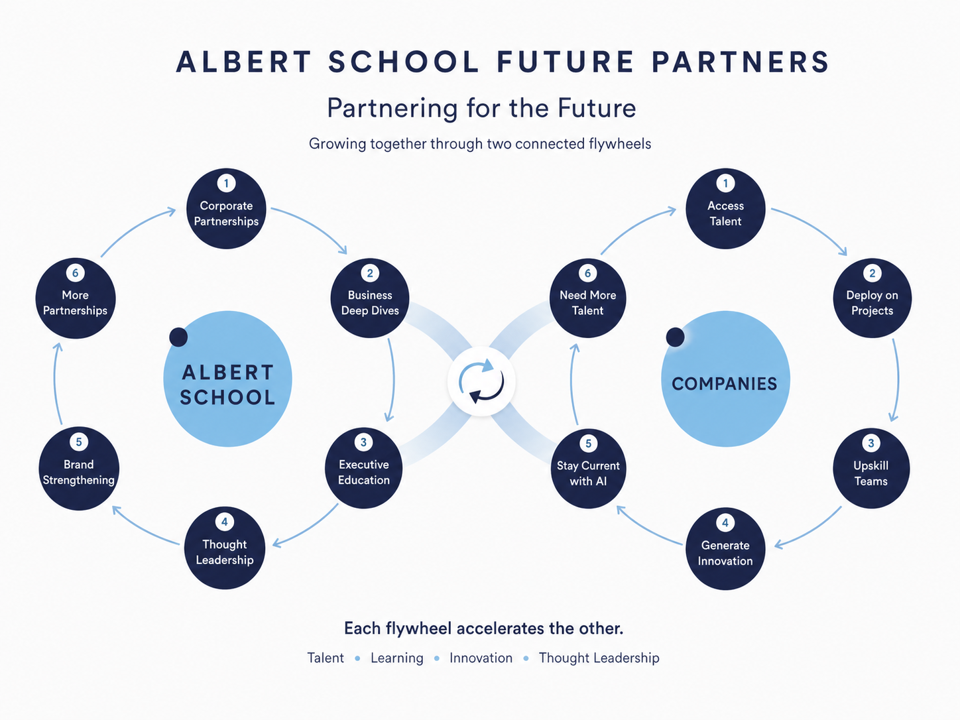
Better partners give us richer cases, which produce stronger student outcomes, which generate better placements and reputation, which attract better partners. The Albert School loop accelerates as the partner network deepens.
Engagement with Albert opens access to hybrid talent and applied research, which speeds AI adoption inside the organisation, which builds competitive advantage and capital to reinvest in talent and R&D, which deepens the engagement with Albert. The partner loop accelerates as the engagement matures.
How the two loops couple.
Albert School supplies the partner with talent and applied research. The partner supplies Albert with real cases and reputation. Each turn on one side accelerates the other. That is the Future Partners architecture in one sentence — and it is the reason we are selective about who we build this with.
Two new combinations. We need a test partner.
The single-pillar engagement model — a BDD alone, an ExecEd module alone, an apprenticeship hire alone — has taken us a long way. The next horizon is in the combinations. Two combinations in particular are the ones we believe will define the Future Partners architecture in the coming years. We want to test them with the right partner. Edmond de Rothschild is at the top of our list.
Business Deep Dive + Executive Education
What it is: a partner organisation runs a Business Deep Dive on a strategic question — and the team inside the organisation that owns that question goes through a calibrated Executive Education module in parallel. The students explore the question fresh; the team sharpens its own readiness to act on the answer. Two parallel learning curves, one shared question.
What it could be at Edmond de Rothschild: a Business Deep Dive on an AI-related question for one of the group's businesses — paired with a focused ExecEd module for the team that would own the recommendation.
Why it needs a test partner: this combination has never been run end-to-end. We have the components; we need the first integrated delivery.
Apprenticeship + Executive Education
What it is: a partner organisation hires an Albert School apprentice into a team — and the team that receives the apprentice goes through a short ExecEd module on how to work with an AI-augmented junior. The apprentice arrives equipped. The team arrives ready. Both learn together. The integration accelerates.
What it could be at Edmond de Rothschild: an apprentice hired into one of the group's entities (a pipeline we already have open) — paired with a half-day ExecEd module for the receiving team on getting the most from an AI-augmented junior in a private banking context.
Why it needs a test partner: most organisations hire apprentices and train the apprentice. The combination treats it as an integration problem — the team is the variable that determines whether the apprenticeship succeeds. We want to prove the model.
Both combinations are deliberately ambitious. Both require a partner organisation willing to experiment, to share what works and what doesn't, and to co-build the playbook the rest of the Future Partners network will use. That is the partnership we are asking Edmond de Rothschild to consider.
Edmond de Rothschild already shares the diagnosis. The question is what to build on it.
This section is our outside reading of the strategic direction we observe at Edmond de Rothschild — to be challenged together. Three points of alignment we see; the rest is for the conversation.
A clear public thesis
Edmond de Rothschild has spoken openly about AI, automation, and shifting demographics redefining the private banking and asset management business. That is not a tactical view — it is a strategic one.
the question is no longer whether AI will reshape the work; the question is how the institution prepares the people who do the work. That is exactly where Albert School operates.
A bespoke positioning
Edmond de Rothschild competes on the quality of the relationship and the depth of the service — not on AI-at-scale. The right framing of any AI engagement here is not "how do we deploy more tools" but "how do we keep the signature of service that defines the house."
any executive education designed for Edmond de Rothschild has to start from this point. A generic "AI for Bankers" program would miss what makes the firm singular.
A multi-entity reality
Edmond de Rothschild operates in Key Hubs — Switzerland (Geneva), France (Paris), and Luxembourg — with European Offices in Belgium, Germany, Italy, Netherlands, Portugal, Spain, and the UK. Each geography has its own clock, its own people, its own AI priority — making it a perfect partner to scale with Albert School.
the right cadre is multi-entity by design. One framework, calibrated geography by geography, coordinated at group level — exactly the structure the Future Partners network is built for.
Five questions to find the right cadence.
This section has no pre-written answers. It exists to structure today's conversation. Your answers determine which of the next moves we lock first.
Would Edmond de Rothschild be open to being the first test partner on one of the two combinations — Business Deep Dive + Executive Education, or Apprenticeship + Executive Education?
Across the group, where is the appetite for upskilling the most concrete right now — Banque Privée, Asset Management, Operations, or a population we haven't named?
How do the L&D function and the business sponsors typically work together on a decision like this — what is the path that gets us from interest to first cohort?
On the Future Partners architecture itself — does the multi-pillar, multi-year framing match how Edmond de Rothschild thinks about external partnerships, or does it need to be reframed?
If we had the right answer to the three questions above, what would prevent us from launching a first test in the second half of 2026?
Albert School in ninety seconds.
The official school presentation — for anything beyond today's conversation.
To continue the conversation.
Albert School contacts
- Angelo AntinoroGeneral Manager, Executive Education & Corporate Relationsaantinoro@albertschool.com
- Henry KoopmanAccount Executivehkoopman@albertschool.com
- Matteo BianchiDirector, Albert School — Switzerlandmbianchi@albertschool.com